Research First India · The size of the opportunity
Is it worth ten years of your life?
A fair question for anyone thinking of giving a career to Indian research. This page answers it in three parts: how much of what India buys is really paying for knowledge, one worked example you can change yourself, and 74 areas where that knowledge could be India's own.
How much of a price is materials, and how much is knowledge?
The idiot index is a product's price divided by the cost of its raw materials. The engineers who coined it used it to find where a part costs far more than the stuff it is made of. A high index is not a scam: the gap pays for design, calibration, software, testing, support and low production volumes. But a high index on something India buys in large numbers is a sign that the knowledge, not the material, is what India is paying for. That knowledge is what research builds.
Stemious estimates from a parts-level analysis of 69 wireless educational sensors and instruments at international list prices, September 2026. Material costs are estimates, not teardowns. The import multiplier uses ₹88 per USD, 8% freight and insurance, 10% customs duty plus surcharge, 18% IGST and 3% handling.
An India-made classroom spectrophotometer.
A spectrophotometer shines light through a sample and measures which colours it absorbs. Every chemistry and biology lab needs one, and colleges import them. Here is what is inside one, roughly what it costs to make, and what an Indian version could mean.
Stemious estimate, not a teardown. Imported classroom spectrophotometers sell in India for roughly ₹60,000 to ₹1,00,000 before GST.
About 45,000 colleges: AISHE 2021-22 lists 45,473 registered colleges. Schools, research labs and exports are left out, so the market shown is the smallest one. Change the sliders to test your own view.
- Optics: grating and light path, tested in physics departments
- Electronics and firmware: sensor readout and Bluetooth, in electronics colleges
- Calibration: shared reference solutions, checked by chemistry labs everywhere
- Software and recipes: the app and the experiments, by computer science teams
- Industry: an Indian manufacturer that builds and services it
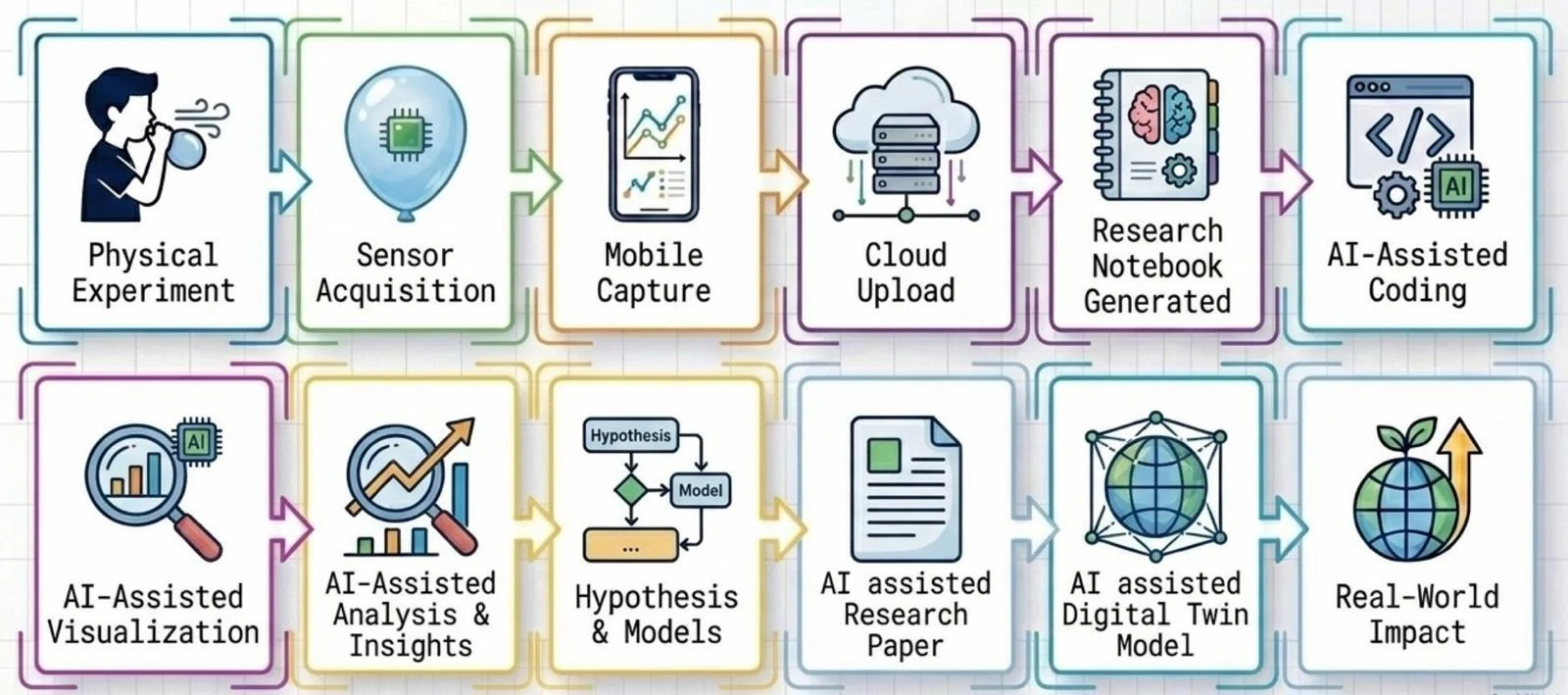
- Optical and circuit designs simulated with AI help before anything is built
- Firmware and analysis code drafted by AI, checked by people
- Many colleges test prototypes in parallel and repeat each other's results
- Open designs mean every round starts from the last one
AI does not replace the lab. It removes the waiting around it.
The slow parts of research used to be reading, coding, analysing and writing. AI now helps with all four, so a researcher's years go further. The physical work still takes the time it takes, and every AI step is checked and disclosed.
Where India's knowledge could be its own.
Fifty national research areas, plus 24 next-generation areas that young researchers are drawn to, 14 of them in electronics. Each card is the start of a business case: why India, what it brings, how large it could be by about 2047, how sure we are, and whether many colleges can work on it together.
Opportunity is the indicative annual value or market in India around 2045 to 2050, built from a published anchor figure and a stated assumption (open "How we sized it"), at ₹88 per USD. These are scenarios to help set priorities, not forecasts, revenue, committed funding or demonstrated impact. Several anchors are low-confidence, and some areas overlap, so the totals must not be added up as one figure. Full business cases and pitch decks are being written mission by mission.